Download the Conference Proceedings
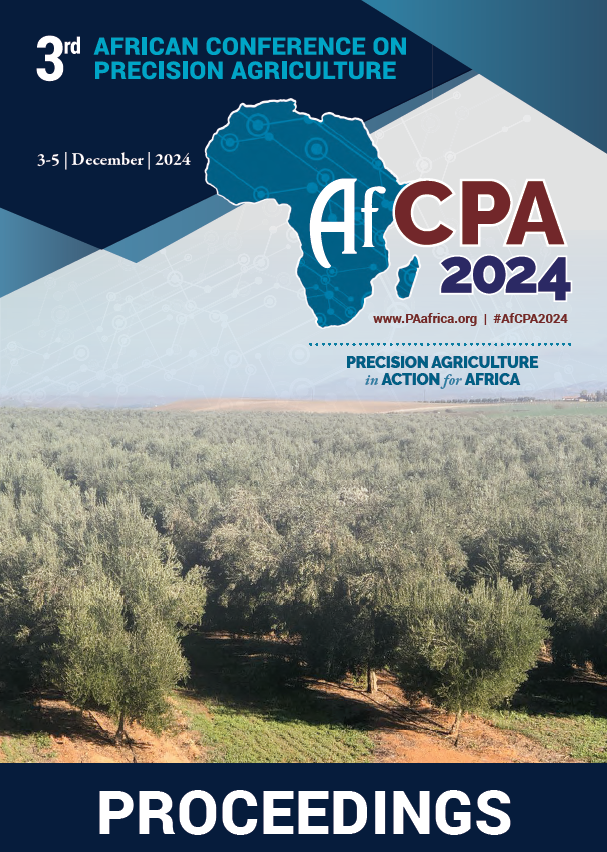
 
Get your copy of the 2024 African Conference on Precision Agriculture Proceedings today! Download the PDF file and view all of the available proceedings.
AfPCA Proceedings 2024

Proceedings

Find matching any: Reset
Dossa, B.M
Khosla, R
MUGI, E
Nabil, M
Pirotti, F
MECHRI, M
Vanlauwe, B
MOUHAMADOU, L
CHEIKH M'HAMED, H
Söderström, M
Ragán, P
Add filter to result:
Authors
Vanlauwe, B
Amede, T
Baudron, F
Chivenge, P
Devare, M
Saito, K
Kihara, J
Nangia, V
Pypers, P
Shepherd, K
Vandamme, E
Rátonyi, T
Ragán, P
Széles, A
Fejér, P
Harsányi, E
Bácskai, I
Ragán, P
Rátonyi, T
Széles, A
Fejér, P
Bácskai, I
Harsányi, E
Ragán, P
Harsányi, E
Rátonyi, T
Széles, A
Fejér, P
Bácskai, I
Söderström, M
Piikki, K
Kihara, J
Mutua, J
Wetterlind, J
HAJRI, R
REZGHUI, M
MECHRI, M
BEN YOUNES , M
Yamungu, A.B
Egeru, A
Majaliwa, M.J
Dossa, B.M
Alshihabi, O
Nouiri, I
Mechri, M
Angar, H
Piikki, K
Martinsson, J
Söderström, M
Kayad, A
Sozzi, M
Pirotti, F
Marinello, F
Sartori, L
Gatto, S
BARBOUCHI, M
BAHRI, H
SOUISSI, A
CHEIKH M'HAMED, H
ANNABI, M
Khosla, R
Söderström, M
Persson, K
Amin, M.E
Abdelfattah, M.A
Mohamed, E.S
Belal, A.A
Nabil, M
Mahmoud, A.G
MECHRI, M
Topics
Decision Support Systems
Mapping and Geostatistics
On-Farm Experimentation
Precision Nutrient Management
Precision Water Management
Climate Smart Agriculture
Satellite Imagery
Precision Agriculture for Small Holders
Proximal and Remote Sensing
Precision Planting/Harvesting
Plenary Session
Type
Oral
Poster
Year
2020
2022
Home » Authors » Results

Authors

Filter results14 paper(s) found.

1. Excellence in Agronomy 2030: A new CGIAR-wide initiative to deliver agronomy solutions at scale

Required increases in crop production and productivity in sub-Saharan Africa (SSA) will not happen without the increased use of appropriate agronomic practices. While several thousand new varieties of nearly all key crops have been produced in the past decade, recent increases in yields in specific countries have only happened when such varieties received the right agro-inputs and management. That said, agronomy is often highlighted as an area that has not delivered impact at scale in SSA, or... B. Vanlauwe, T. Amede, F. Baudron, P. Chivenge, M. Devare, K. Saito, J. Kihara, V. Nangia, P. Pypers, K. Shepherd, E. Vandamme

2. Preparation of a precision ripping plan using manual vertical penetrometer measurements

Large weight power engines and tools used in agriculture significantly contribute to the formation of compacted and thickening layers starting from the soil surface. There are suitable deep ripping technologies to eliminate harmful soil compaction, which are extremely energy and cost demanding. In precision agriculture, it is possible to treat spatially delimited unfavourable soil patches. The bulk density (g/cm3) of the soil was calculated from the soil resistance and moisture content... T. Rátonyi, P. Ragán, A. Széles, P. Fejér, E. Harsányi, I. Bácskai

3. A cheap alternative to data management and creating of yield maps of small-plot field experiments

Long-term field trials provide an opportunity to examine the long-term effects of crop production factors and the effect of different crop years can also be analysed. In the long-term field trial, spatial representation of the data belonging to each plot might be necessary for the purpose of soil heterogeneity analysis, working hypothesis, or even presentation. Researchers dealing with long-term field trials usually store the measurement data for a given experiment in Excel or in a database of... P. Ragán, T. Rátonyi, A. Széles, P. Fejér, I. Bácskai, E. Harsányi

4. Soil mapping with the VERIS U3 soil scanner in a precision farm in Hungary

Currently, field crop production faces constant challenges. Extreme climatic conditions, deteriorating circumstances on the field have a negative impact on the quantity and quality of available yields, and the ever-changing agro-economic environment makes the profitability of the sector uncertain. Precision crop production means site-specific agricultural cultivation tied to geographical coordinates. Modern strip tillage technology based on precision technology for crops with wide row spacing... P. Ragán, E. Harsányi, T. Rátonyi, A. Széles, P. Fejér, I. Bácskai

5. Mapping spatial variability of soil nutrient deficiencies in smallholder villages – a prerequisite for improved crop production in Africa

Smallholder farming is the dominating type of agricultural production in many parts of Africa. If cultivation practices can be adapted to match the specific needs of individual smallholder plots, this can certainly be regarded as a form of precision agriculture (PA), considering their limited size. A fundamental prerequisite for successful application of PA is the availability of basic information on soil properties at a detailed enough level. To fill yield gaps, site specific information must... M. Söderström, K. Piikki, J. Kihara, J. Mutua, J. Wetterlind

6. Crop water requirements, biomass and grain yields estimation for Sulla (Hedysarum coronarium L.) using cropwat in semi-arid regions of Tunisia

Dwindling water resources and increasing food requirements require greater efficiency in water use, both in rainfed and in irrigated agriculture. Regulated deficit irrigation provides a means of reducing water consumption while minimizing adverse effects on yield. With the current water shortage in Africa improving crop water use is vital especially in the arid and semi-arid regions.  Models can play a useful role in developing practical recommendations for optimizing crop production under... R. Hajri, M. Rezghui, M. Mechri, M. ben younes

7. SIMULATION OF CASSAVA YIELD UNDER DIFFERENT CLIMATIC SCENARIOS IN KILEMBWE, SOUTH-KIVU PROVINCE EASTERN DR CONGO

Climate variability and change are projected to significantly impact agricultural production across Africa. This study assessed the effects of climate variability and change on cassava yield in Kilembwe, South-Kivu province Eastern DR Congo. The assessment relies on the DSSAT crop model simulation of cassava under current and future climate. The period 1980–2010 was used to represent the baseline, while future projection covers three periods including the near future (2010–2039), mid-century... A.B. Yamungu, A. Egeru, M.J. Majaliwa, B.M. Dossa

8. CropSAT – opportunities for applications in precision agriculture in Africa

The present paper aims at describing the CropSAT system, a Sentinel-2-based interactive decision support system (DSS) that provides vegetation index (VI) maps free-of-charge all across the globe for different applications in precision agriculture. We summarize research results from the ongoing developmental process and pointing to opportunities for development and application in precision agriculture in Africa. The DSS was initially developed in a research project at the Swedish University of... O. Alshihabi, I. Nouiri, M. Mechri, H. Angar, K. Piikki, J. Martinsson, M. Söderström

9. Monitoring Corn (Zea mays) Yield using Sentinel-2 and Machine Learning for Precision Agriculture Applications

Currently, there is a growing demand to apply precision agriculture (PA) management practices at agricultural fields expecting more efficient and more profitable management. One of PA principal components for site-specific management is crop yield monitoring which varies temporally between seasons and spatially within-field. In this study, we investigated the possibility of monitoring within-field variability of corn grain yield in a 22ha field located in Ferarra, North Italy. Archived yield data... A. Kayad, M. Sozzi, F. Pirotti, F. Marinello, L. Sartori, S. Gatto

10. Soil organic carbon mapping in Tunisia: comparison of different interpolation methods

Soil organic carbon (SOC) stock is an important carbon pool in terrestrial ecosystems. It plays an important role in agricultural productivity and is often used as a key indicator of soil quality whether for soil fertility or climate regulation. SOC stocks are difficult to estimate due to the large spatial variability. In this way, many different techniques have been conducted for predicting and mapping SOC content. However, although numerous techniques are in use, there is still debate on which... M. Barbouchi, H. Bahri, A. Souissi, H. Cheikh m'hamed, M. Annabi

11. Scale Independent Precision Agriculture

The advent of precision agriculture that occurred in the USA about three decades ago involved application of advanced and innovative technologies. Precision agriculture in the US and other advanced countries continued in that direction and today it is more sophisticated and complex than before.  Interestingly, the concept of Precision Agriculture is relatively simple and does not mandate utilization of advanced technologies to practice precision agriculture. For example, it may take a suite... R. Khosla

12. From Drone to Satellite – Does It Work?

Multispectral drone-sensors are useful for detailed studies of crop characteristics in field trials, e.g. to create prediction models on nitrogen (N) uptake, or even estimates of optimal N rate to apply. To enable wide application of such models, they may be applied in satellite image-based decision support systems for farmers. However, successful transfer of models based on spectral data from one platform to another, requires strong and stable correlation between data from the different sensors.... M. Söderström, K. Persson

13. Potato Yield Prediction Using Multi-temporal Sentinel-2 Data and Multiple Linear Regression

Traditional potato growth models have a number of flaws, i.e., the cost of data collection, quality of input data, and the absence of spatial information in some cases. To address these challenges, we created a multiple linear regression model (MLRM) that uses the multi-temporal Sentinel-2 derived indices to predict potato yield. Along the growing season (from October 2019 to February 2020) eight Sentinel-2 imageries were collected, afterwards, the normalized difference vegetation index (NDVI)... M.E. Amin, M.A. Abdelfattah, E.S. Mohamed, A.A. Belal, M. Nabil, A.G. Mahmoud

14. Decision-Making Tools in Soil Management and Plant Nutrition On-Farm Research and Observation Plot: Between Reality and Challenges

In this presentation, we will address a number of decision-making tools and assess their relevance and limitations for the Mediterranean and Tunisia's agricultural conditions. Decision-making tools can be classified, based on the scale, to different levels, ranging from national and regional scale to farm scale. On a large scale, an agricultural policy can be drawn based on the governmental agricultural plans, and soil maps can be adopted as a decision-making tool and thus guide support in... M. Mechri