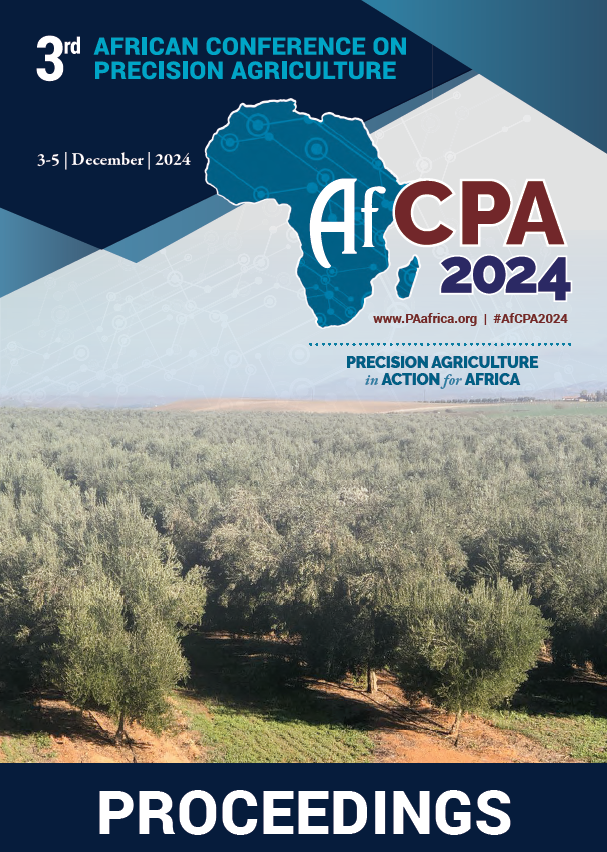
Download the Conference Proceedings

 
Get your copy of the 2024 African Conference on Precision Agriculture Proceedings today! Download the PDF file and view all of the available proceedings.
AfPCA Proceedings 2024

Proceedings

Find matching any: Reset
Woods, S
Saito, K
Lutomia, C
Woldekristos, A.N
LEE, J
Add filter to result:
Authors
Vanlauwe, B
Amede, T
Baudron, F
Chivenge, P
Devare, M
Saito, K
Kihara, J
Nangia, V
Pypers, P
Shepherd, K
Vandamme, E
Peets, S
Woods, S
MORIMOTO, E
LEE, J
NONAMI, K
MATUMURA, I
IKEBE, M
SATO, S
Chivenge, P
Saito, K
Bunquin, M
Sharma, S
Dobermann, A
Kenea, W.B
Tura, T.B
Woldekristos, A.N
Adolwa, I
Muthamia, J
Lutomia, C
Cook, S
Kenea, W
Woldekristos, A.N
Balemi, T
Topics
Decision Support Systems
Precision Agriculture for Small Holders
Precision Agriculture for Field and Plantation Crops
Precision Nutrient Management
On-Farm Experimentation
Small Holders and Precision Agriculture
Type
Oral
Year
2020
2022
2024
Home » Authors » Results

Authors

Filter results7 paper(s) found.

1. Excellence in Agronomy 2030: A new CGIAR-wide initiative to deliver agronomy solutions at scale

Required increases in crop production and productivity in sub-Saharan Africa (SSA) will not happen without the increased use of appropriate agronomic practices. While several thousand new varieties of nearly all key crops have been produced in the past decade, recent increases in yields in specific countries have only happened when such varieties received the right agro-inputs and management. That said, agronomy is often highlighted as an area that has not delivered impact at scale in SSA, or... B. Vanlauwe, T. Amede, F. Baudron, P. Chivenge, M. Devare, K. Saito, J. Kihara, V. Nangia, P. Pypers, K. Shepherd, E. Vandamme

2. Mechanisation of smallholders in Zambia by agrodealer development

The main challenges hampering agricultural mechanization in sub-Saharan Africa (SSA) are affordability, availability, lack of farmer skills and constraints within the private sector. Smallholders are trapped in a vicious circle of low income, low demand, high cost, and lack of financing. Low capacity and lack of support for mechanisation contractors (agrodealers) to succeed is holding back the development. The objectives of this work were (i) to assess the affordability of mechanisation systems... S. Peets, S. Woods

3. Development of Canopy Mapping System of Asian pears (Pyrus pyrifolia Naka) Using Terrestrial Laser Scanning

In this paper, the canopy mapping system (CMS) of Asian pears for estimating yield during Bud thinning and Pruning operations using point cloud data was proposed. Bud thinning and Pruning in Asian pear (Pyrus pyrifolia Naka) is necessary to ensure quality and yield but is time-consuming and heavily depends on work knowledge. This study described a method of estimating the number of fruits through the length of a branch based on remote sensing. The CMS would be useful to support more efficient... E. Morimoto, J. Lee, K. Nonami, I. Matumura, M. Ikebe, S. Sato

4. Nutrient management tailored to smallholder agriculture enhances productivity and sustainability

Plant nutrition plays a central role in the global challenge to produce sufficient and nutritious food, lessen rural poverty, and reduce the environmental footprint of crop production. Efficient fertilizer use requires tailored solutions that are scientifically sound, practical and scalable especially for smallholder farmers, such as the crop-led site-specific nutrient management (SSNM) approach developed in the 1990s for cereal production systems in Asia to address variability among farms. Originating... P. Chivenge, K. Saito, M. Bunquin, S. Sharma, A. Dobermann

5. Precision Maize Nutrition: Evidences from On-farm Experimentation of Quefts Estimated Nutrient Requirement for Variable Densities in Smallholder Farmers in Ethiopia

Quantitative Evaluation of the Fertility of Tropical Soils (QUEFTS) model is an important tool for estimating optimal nutrient requirement of crops. The study was conducted to evaluate QUEFTS estimated (QE) nutrient requirement of maize in two pant densities (32,443 and 53,333 plants/ha in Central Rift Valley (CRV); 27724 and 62,000 plants/ha in Jimma) on fields of three farmers wealth classes (poor, medium and wealth) in contrasting agro-ecologies of Ethiopia. QUEFTS follows a target oriented... W.B. Kenea, T.B. Tura, A.N. Woldekristos

6. The Value and Potential of On-Farm Experimentation to Catalyze Agricultural Transformation

On-farm experimentation (OFE), which inculcates farmers’ agency in knowledge discovery, has the potential to support and accelerate transformative agronomy at scale. The OFE process within the Nutrient-Catalyzed Agricultural Transformation in Africa (NUTCAT) project, encompasses farmer engagements, set-up of simple, easy-to-understand treatment designs, and contextual analysis of the data to enhance the relevance of the results to farmers. Ultimately, it is envisaged that this process will... I. Adolwa, J. Muthamia, C. Lutomia, , S. Cook

7. Sustainability of Maize Production with Farmers’ Practices and Redesigned Crop Management Practices in CRV and Jimma of Ethiopia

Multi-criteria assessment of crop management practices is vital for sustainable crop production and environmental safety. In this study, sustainability of maize production with farmer’s practice (FP), redesigned plant density plus current fertilizer use (RDCF), current plant density plus redesigned fertilizer use (CDRF), and redesigned plant density and redesigned fertilizer use (RDRF) were assessed at farm level based on social, agronomic, economic and environmental principles in Central... W. Kenea, A.N. Woldekristos, T. Balemi