Download the Conference Proceedings

 
Get your copy of the 2024 African Conference on Precision Agriculture Proceedings today! Download the PDF file and view all of the available proceedings.
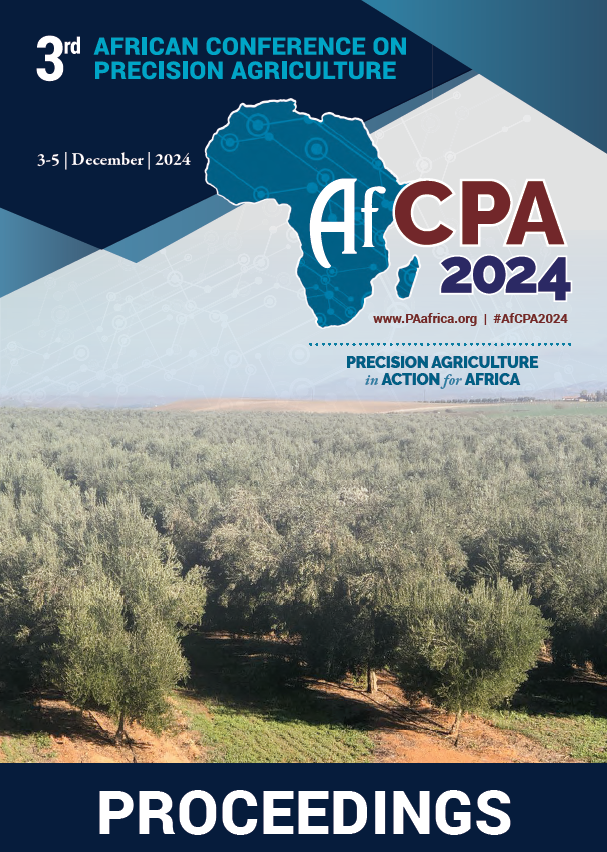
AfPCA Proceedings 2024

Proceedings

Find matching any: Reset
Nyamayevu, D
Fadairo, O
KINDIKIZA, D
Ndlovu, S
Kihara, J
Hassan, D
MECHRI, M
Frimpong, K
Mcnairn, H
Olutoberu, T
Maina, E.W
Higuti, V.A
Kabir, M
Frija, A
Add filter to result:
Authors
Vanlauwe, B
Amede, T
Baudron, F
Chivenge, P
Devare, M
Saito, K
Kihara, J
Nangia, V
Pypers, P
Shepherd, K
Vandamme, E
Söderström, M
Piikki, K
Kihara, J
Mutua, J
Wetterlind, J
HAJRI, R
REZGHUI, M
MECHRI, M
BEN YOUNES , M
Rudiger, U
Aidoudi, Z
Frija, A
Rekik, M
Zaiem, A
Cheikh, H
Higuti, V.A
Velasquez, A.E
Gasparino, M.V
Magalhães, D.V
Becker, M
Milori, D.M
Aroca, R.V
Soaud, A
Abou-Zeid , S
Ali, A
Hassan, D
Maina, E.W
Maina, E.W
choukri, M
Laamrani , A
simonneaux , V
Gerard , B
Belaqziz, S
Chehbouni, A
misbah, K
Mcnairn, H
Kabir, M
Ekici, S
MECHRI, M
Ndlovu, S
Mutsamba-Magwaza, E
Nyamayevu, D
Nyamadzawo, G
Mandumbu, R
Nyagumbo, I
KINDIKIZA, D
Olutoberu, T
Topics
Decision Support Systems
Precision Nutrient Management
Precision Water Management
Robotics, Automation, and Small Farm Mechanization
Precision Nutrient Management
Mapping and Geostatistics
Robotics, Automation, and Small Farm Mechanization
Plenary Session
Water Management for Precision Agriculture
Type
Oral
Year
2020
2022
2024
Home » Authors » Results

Authors

Filter results14 paper(s) found.

1. Excellence in Agronomy 2030: A new CGIAR-wide initiative to deliver agronomy solutions at scale

Required increases in crop production and productivity in sub-Saharan Africa (SSA) will not happen without the increased use of appropriate agronomic practices. While several thousand new varieties of nearly all key crops have been produced in the past decade, recent increases in yields in specific countries have only happened when such varieties received the right agro-inputs and management. That said, agronomy is often highlighted as an area that has not delivered impact at scale in SSA, or... B. Vanlauwe, T. Amede, F. Baudron, P. Chivenge, M. Devare, K. Saito, J. Kihara, V. Nangia, P. Pypers, K. Shepherd, E. Vandamme

2. Mapping spatial variability of soil nutrient deficiencies in smallholder villages – a prerequisite for improved crop production in Africa

Smallholder farming is the dominating type of agricultural production in many parts of Africa. If cultivation practices can be adapted to match the specific needs of individual smallholder plots, this can certainly be regarded as a form of precision agriculture (PA), considering their limited size. A fundamental prerequisite for successful application of PA is the availability of basic information on soil properties at a detailed enough level. To fill yield gaps, site specific information must... M. Söderström, K. Piikki, J. Kihara, J. Mutua, J. Wetterlind

3. Crop water requirements, biomass and grain yields estimation for Sulla (Hedysarum coronarium L.) using cropwat in semi-arid regions of Tunisia

Dwindling water resources and increasing food requirements require greater efficiency in water use, both in rainfed and in irrigated agriculture. Regulated deficit irrigation provides a means of reducing water consumption while minimizing adverse effects on yield. With the current water shortage in Africa improving crop water use is vital especially in the arid and semi-arid regions.  Models can play a useful role in developing practical recommendations for optimizing crop production under... R. Hajri, M. Rezghui, M. Mechri, M. ben younes

4. Small Machinery for Sustainable Intensification of Crop-Livestock System under Biomass Shortage

Small crop-livestock systems in Low- and Middle-Income Countries (LMIC) such as North African ones are characterized by low mechanization levels, thus undermining their productivity and sustainability. Machinery being promoted in local markets are made and imported mostly from industrial countries where farm systems are larger in terms of size. Prices of these machines are not affordable for small to medium sized land-holding farmers who remain incapable of upgrading and modernizing their farming... U. Rudiger, Z. Aidoudi, A. Frija, M. Rekik, A. Zaiem, H. Cheikh

5. LiDAR-based soybean crop segmentation for autonomous navigation

The technological advances in the last few decades have greatly changed agricultural operations. In order to became safer, more profitable, efficient, and sustainable, modern farms have adopted the use of sophisticated technologies, such as robots, sensors, aerial images, and GNSS (Global Navigation Satellite System). These technologies not only increase the crop productivity, but also reduce the wide use of water, fertilisers, and pesticides. Due to this, they reduce costs and negative environmental... V.A. Higuti, A.E. Velasquez, M.V. Gasparino, D.V. Magalhães, M. Becker, D.M. Milori, R.V. Aroca

6. Chlorophyll Meter Based Precision Nitrogen Management in Maize Grown in Alluvial Soil in Egypt

Precision nitrogen (N) management is essential for profitable crop production and to minimize N losses to the environment that are a consequence of an excessive N supply. Chlorophyll meter-based N management can help to achieve high N use efficiency, as aquick and non-destructive spectral characteristics of leaves, which can be used to diagnose plant N deficiency and graduate N fertilization with improve N use efficiency. Field experiments were conducted during two consecutive years, 2019 and... A. Soaud, S. Abou-zeid , A. Ali, D. Hassan

7. Effect of Different Combinations of N, P and K Nutrients on Growth, Yield and Fibre Quality of Cotton (Gossypium Hirsutum L.)

Cotton has high requirements for nitrogen (N) phosphorus (P) and potassium (K), and the nutrients interact differently on yield and quality of this crop. This necessitates the precise combination of these nutrients to maximize yield and quality. Two cotton varieties (Bt cotton and a conventionally bred variety, HART 89M) were assessed for growth, yield and quality under different nutrient combinations in two contrasting environments in semi-arid Kenya. Nutrient combinations were NPK,... E.W. Maina, E.W. Maina

8. Use of Earth Observation Imagery, Advanced Modelling Algorithms and Other Monitoring Systems to Produce Operational Agricultural Annual Crop Inventories for Morocco.

African farmers are facing the challenges of a changing climate, increased temperatures, changes in rainfall patterns, more frequent extreme weather events and reductions in water availability. The digital transformation of the agricultural sector is one of the opportunities that can promote good practices of the African agricultural through  the sharing of information and tools for decision-making, thereby, boost economic growth of our African country. The shift to digital technologies is... M. Choukri, A. Laamrani , V. simonneaux , B. Gerard , S. Belaqziz, A. Chehbouni, K. Misbah, H. Mcnairn

9. Potentials of Unmanned Aerial Vehicles (UAVs) for the Nigerian Agriculture

The continuous development of technology is driving the invention of new machineries such as the Unmanned Aerial Vehicles (UAVs), also known as “drones”. The UAVs have become much more popular within the last decade for its significant roles in agriculture among other industries, yet their applications in Nigeria are yet to be appreciated. Therefore, the present study reviewed the characteristics and multiple uses of UAVs in agriculture and their potentials for the Nigerian... M. Kabir, S. Ekici

10. Decision-Making Tools in Soil Management and Plant Nutrition On-Farm Research and Observation Plot: Between Reality and Challenges

In this presentation, we will address a number of decision-making tools and assess their relevance and limitations for the Mediterranean and Tunisia's agricultural conditions. Decision-making tools can be classified, based on the scale, to different levels, ranging from national and regional scale to farm scale. On a large scale, an agricultural policy can be drawn based on the governmental agricultural plans, and soil maps can be adopted as a decision-making tool and thus guide support in... M. Mechri

11. The Future of Farming: Bringing Biophotonics and Machine Learning to Revolutionize Agriculture

The future of farming is set to be revolutionized by biophotonics and machine learning. Biophotonics is the study of the interaction of light and living matter, and machine learning is a form of artificial intelligence that allows computers to learn from data. Together, these two technologies will allow for more precise and efficient farming, as well as greater yields and less wastage. Biophotonics will allow for more precise targeting of crops with pesticides and herbicides, as well as more efficient... S. Ndlovu

12. Rainwater Harvesting and Nutrient Intensification in Maize-Legume Farming Systems in Semi-Arid Zimbabwe

Agricultural productivity in Zimbabwe is declining mainly due to climate change and inherently poor soil fertility. The situation is worsened by the high cost of fertilizers beyond the reach of many smallholder farmers. In response to these challenges, most smallholder farmers are implementing either rainwater harvesting (RWH) or integrated soil fertility management (ISFM). This study sought to investigate the role of integrating the tied-contour RWH (TC-RWH) technique and ISFM on soil moisture,... E. Mutsamba-magwaza, D. Nyamayevu, G. Nyamadzawo, R. Mandumbu, I. Nyagumbo

13. Real-Time Moisture Control in Irrigation Systems for Water Use Efficiency and Climate Change Resilience. A Review

Due to the increasing water scarcity and uncertainties of climate change, improving crop water use efficiency and productivity, at the same time minimizing detrimental effects on the environment to meet the world's rising food demand. Thus, is necessary to adopt innovative irrigation strategies, such as drip irrigation. Smart irrigation has a potential of improving water use efficiency in precision agriculture. Conventionally, irrigation systems rely on heuristic methods in order to schedule... D. Kindikiza

14. Land Suitability Prediction for Maize Production in Southwest Nigeria Using Geographical Information System and Mostlimiting Soil Native Fertility Factors

... T. Olutoberu