Download the Conference Proceedings
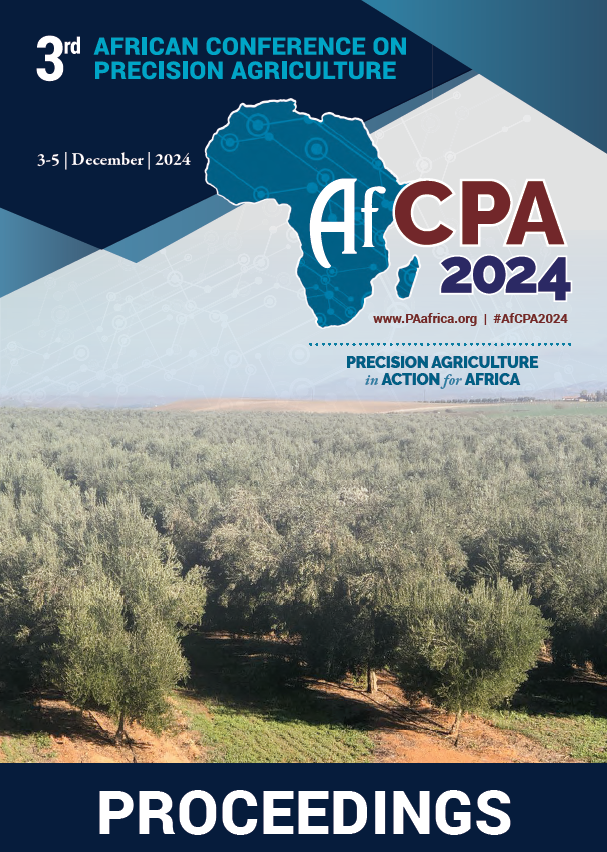
Proceedings
Authors
| Filter results10 paper(s) found. |
|---|
1. Development of Canopy Mapping System of Asian pears (Pyrus pyrifolia Naka) Using Terrestrial Laser ScanningIn this paper, the canopy mapping system (CMS) of Asian pears for estimating yield during Bud thinning and Pruning operations using point cloud data was proposed. Bud thinning and Pruning in Asian pear (Pyrus pyrifolia Naka) is necessary to ensure quality and yield but is time-consuming and heavily depends on work knowledge. This study described a method of estimating the number of fruits through the length of a branch based on remote sensing. The CMS would be useful to support more efficient... E. Morimoto, J. Lee, K. Nonami, I. Matumura, M. Ikebe, S. Sato |
2. Soil fertility mapping of Dry savannah zone of TogoIncreasing agricultural productivity and therefore the production requires a good knowledge of the soil fertility status and a sustainable nutrients management. The objective of this study is to map spatial distribution of some selected soil fertility parameters in the dry savannah agro-ecological zone that covers the regions of Savanes and Kara in Togo. Soil fertility parameters such as pH, available phosphorus (P), exchangeable potassium (K) and organic matter were determined in soil samples... K.K. Ganyo, K.A. Ablede , K. Koudjega, S. Ani, K. Afawoubo, D.A. Anoumou, A.T. Mensah, E. Assih-faram, M. Tchalla-kpondji, K. Kpemoua, Y. Lombo |
3. Development of Lodging Direction Determination System Using Image ProcessingIn this study, image processing system was developed for application on rice plants to determine lodging condition, which was contributing factor to declining harvester efficiency by using combine harvester. Therefore, We developed a system for determination of the lodging direction by algorithm based on convolutional neural network (CNN). As for deep learning framework, Pytorch1.1.0 were used to train and test the judging direction. GoogLeNet was used as a pre-trained CNN model. Lodging... E. Morimoto, Y. Arai, K. Nonami, T. Ito |
4. Lime and Phosphorus Effects on Soil Acidity and Malt Barley Phosphorus Use Efficiency in Welmera District, Central Highlands of EthiopiaIn Ethiopia, about 43% of total arable land affected by soil acidity. Furthermore, phosphorus (P) deficiency is a major constraint to increase crop yields. Efforts to ameliorate the deleterious effects of soil acidity must therefore be accompanied by measures to increase P availability in soils. Therefore, appropriate rate of lime and P fertilizer is an important strategy for improving crop growth in acidic soils. Accordingly, an experiment was undertaken to study lime and P effects on soil acidity... N.T. Geremew, B.B. Waraka, L.W. Mirkena |
5. Engaging Stakeholders in Precision Agriculture Toolbox Conception: Case of Cowpea Atlas Platform Establishment in Benin RepublicCowpea [(Vigna Unguiculata (L.) Walpers] is among the most preferred and consumed legumes in West Africa and grown by many smallholder farmers. The crop has huge potential, is easy to grow and constitute a source of income of many actors involved in different value chains. Unfortunately, despite many interventions which aimed at promoting the crop in West Africa mainly Benin, areas under cowpea crop decrease over the years along with the loss of cowpea-based products. Such problem is... N.V. Fassinou Hotegni, Y.L. Godonou, L.M. Gnanglè, O.N. Coulibaly, E.G. Achigan-dako |
6. Soil Moisture Sensing for Increased Water Use Efficiency and Crop Yields in Furrow Irrigated Systems: a Case of Mubuku Irrigation Scheme in UgandaWater and nutrient use efficiencies remain low in most of the irrigated systems in developing countries, undermining crop productivity in these areas. This is partly due to lack of precise and site-specific information to guide irrigation scheduling. In most cases information on soil properties and crop water requirements is lacking and thus irrigation scheduling is done on rotational basis whether the crop needs water or not. Consequently, the amount of water stored in soil root zone for crop... E. Opolot, D. Besigye, P. Musinguzi, I.N. Alou, T.A. Basamba, G. Olupot |
7. Comparative Assesement of Interpolation Techniques in Predicting Soil Properties on a Sloping Pasture Land Under Fallow in a Ferralsol in UgandaSoil variability is a major challenge in application of mineral fertilizers in Sub-Saharan Africa (SSA). Use of soil fertility maps can effectively guide the use of mineral or organic fertilizers or fertilizers. Interpolation techniques are widely used in the formulation of these fertility maps. The precision of spatial interpolation techniques for predicting unmeasured values have been reported by various researchers but there are cconflicting findings regarding the relative performance of these... J.M. Menya, P. Musinguzi, J.M. Mwanjalolo |
8. A Synopsis of Water and Nutrient Requirements of Hass Avocado for Uganda and Sub-saharan Africa PractitionersHass avocado production is increasing in Uganda and sub-Saharan Africa (SSA) to tap into the lucrative market especially in Western Europe, China, Japan, and Russia. However, there is limited information about its water and nutrient requirements in end-user-friendly formats especially in Uganda and SSA. We consolidated the scanty information about water and nutrient requirements of Hass avocado and made necessary recalculations and unit conversions to aid meaningful uptake of the information by... P.C. Odong, G. Olupot, T.L. Odong, A. Mwije, P. Musinguzi, I.N. Alou, T.A. Basamba, P. Ebanyat, E. Opolot |
9. Implementing Field-Based High Throughput Plant Phenotyping: The Open Source Way... Y. Kassim |
10. The Value and Potential of On-Farm Experimentation to Catalyze Agricultural TransformationOn-farm experimentation (OFE), which inculcates farmers’ agency in knowledge discovery, has the potential to support and accelerate transformative agronomy at scale. The OFE process within the Nutrient-Catalyzed Agricultural Transformation in Africa (NUTCAT) project, encompasses farmer engagements, set-up of simple, easy-to-understand treatment designs, and contextual analysis of the data to enhance the relevance of the results to farmers. Ultimately, it is envisaged that this process will... I. Adolwa, J. Muthamia, C. Lutomia, , S. Cook |